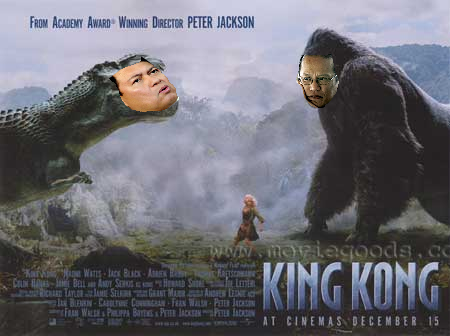
180 Minutes! Is it enough?
Radio airtime quota for nat’l candidates is as long as the ’05 King Kong Movie
Why do national candidates pour out a lot of money on radio ad campaigns? Radio, though, is second to TV, in terms of mass reach. But execution of strategies is limited, no visuals, no fancy graphics, no charm or “pa-cute” approach by celebrity endorsers, unless of course if the endorser’s voice is THAT recognizable.
But why bank on a medium where there is little to make?
As most giant brands are doing, putting ads on radio is as serious as putting 30 seconders on TV. Radio ads are a good follow up to TV campaigns. Radio is everywhere; people listen to radio while on a jeepney, inside a department store or at work.
According to a report by Geovisual Solutions Inc, NRS 2007, radio reaches 90.1% of the listening population aged 13 to 65 years old. In fact, each day of the week, we Filipinos listen more to radio than we do watch TV. On average, listeners tune in to radio for more than an hour and three quarters ( 1 ¾ hours). Filipinos watch TV at an average of 45 minutes each day of the week only.
No question on the viability of radio as advertising medium. However, Resolution No. 8758 on the Fair Elections Act states that presidentiables, particularly, are allowed only 180 minutes total of radio air time usage, for their political campaigns, covering the campaign period from February 9 to May 8, 2010 (3 months).
180 minutes is just like watching the 2005 King Kong remake, if that length was summed up into a movie. But this is radio, we’re talking about audio here. And that 180 minutes is chopped down into spots. 1 spot is equivalent to 1 length or run of a radio ad material, it can be 15 seconds long, 30 seconds, or 60 seconds.
you should be hearing 4 spots per day for every presidentiable
How effective, let alone cost effective, is 180 minutes?
180 minutes = 10,800 seconds of air time
10,800 seconds = 360 thirty-second long radio spots
360 thirty-second spots divided by 3 months = 120 thirty-second spots per month120 thirty second spots per month divided by 30 days = 4 thirty-second spots per day
With the calculations above, you should be hearing 4 spots per day for every presidentiable, assuming that it’s all 30 seconders and assuming that they are all using up their 180-minute quota.
Is that frequency enough? All 9 presidentiables are competing for that precious one hour and three quarters each day.
They should be doing more than the 180-minute allocation. In fact, some candidates have devised a strategy by including themselves in their senators’ ads.
In the 2004 elections, Ping Lacson paid a radio network in Northern Mindanao to help in his campaign
How about paid radio interviews? Are they not counted as a radio ad campaign? A candidate is using radio airtime and is paying for it. Radio networks are not refusing payment for interviewing candidates, that’s money. Why should you turn your back on money?
Radio airtime is a public property. Radio stations do not own it. In fact, they pay the government to use OUR airwaves to make money. And nothing can be more harassing, than while you are listening to your favorite radio drama, suddenly a paid interview for a presidentiable cuts it off.
Politicians can also hire radio people. In fact, a candidate can pay a radio network, and use all its man power for his benefit. In the 2004 elections, Ping Lacson paid a radio network in Northern Mindanao to help in his campaign.
For a campaign strategy that only grabs the ear, politicians will do everything they can to grab not only your ear but your vote as well. Only a few of the presidentiables right now have the fiscal power to implement a campaign strategy that goes way beyond reaching you through radio. So always be aware of what your ears might be hearing.
Inasmuchas we don’t want to pollute our sight with ugly and misplaced political posters, let’s be responsible in using and lending our precious airtime.
 Radio Online Now
hi parechuy nahan gud ko nimo ay mka boang ka dili ko ka 2log og dli ko ka dongog xa imong tingog hahahahahaha…… ms.L
LikeLike
Election spending and spending limits among candidates are among the issues that are less tackled. But the truth is, this these are the most crucial issues during elections as it involves money. The most important questions are, how much money is spent and who gives the money?
After election, the law provides that each candidate must report how much they spent per candidate. surprisingly, in last elections we have, no one overspent though it was very clear that big chunks of money spent. see? Should we get surprised when after election, each candidate reports that they dont overspent?
LikeLike