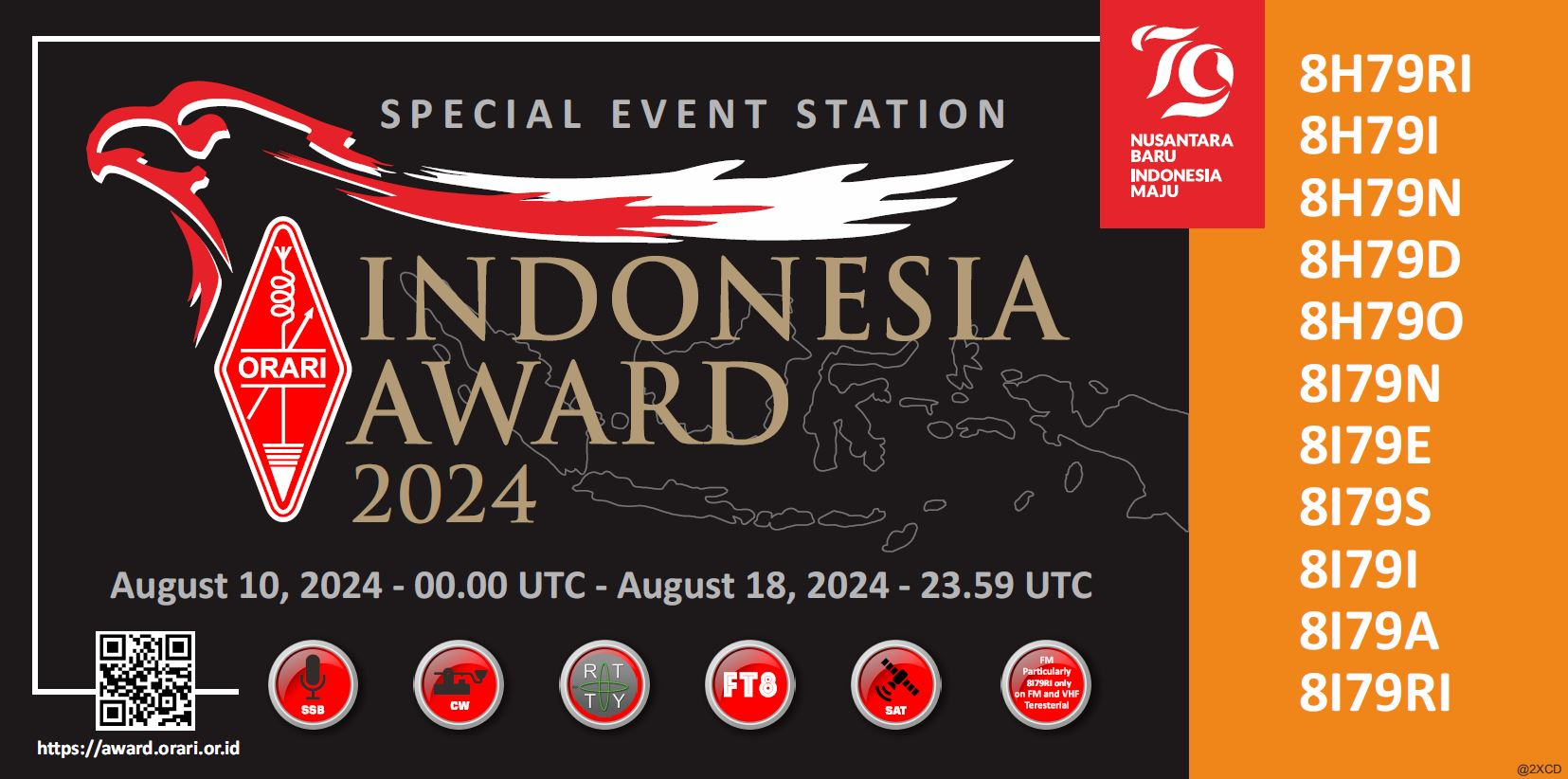
Amateur radio enthusiasts in Indonesia will come together to celebrate their passion and achievements for the Indonesia Award 2024, hosted by ORARI. The event will take place from August 10 to August 18, 2024, and will showcase the remarkable contributions of radio operators across the country.
The Amateur Radio Community
Amateur radio, often referred to as “ham radio,” is a fascinating hobby that allows enthusiasts to communicate over long distances using radio waves. Operators experiment with antennas, frequencies, and modes, connecting with fellow hams worldwide. Beyond the technical aspects, amateur radio serves as a vital lifeline during emergencies, providing communication when other systems fail.
Looking Ahead
As the amateur radio community continues to grow, events like the Indonesia Award serve as a beacon of encouragement. Whether it’s experimenting with new equipment, participating in contests, or assisting during disasters, hams contribute significantly to society.
In the spirit of ORARI’s celebration, let’s raise our antennas and toast to the passionate radio operators who keep the airwaves alive!
If you’ve been using an earlier edition of Broken Air, you’re likely hooked on its sound. Don’t worry, you’re not alone! Imaging directors worldwide are craving even bigger and bolder sounds, and Broken Air 4 delivers.
With 250 FX and work parts designed for CHR, Hot AC, Greatest Hits, and Dance formats, your production will pack a punch and stand out. Whether you’re crafting a new ID or promo for your station or podcast, Broken Air 4 provides all the essential tools.
It includes Breakers, Air Breakers, and Low Breakers perfect for slicing up or separating messages. Get subtle with the fantastic Glitches or go bold with the high-energy Starters. Ensure a smooth flow in your production with Whoosh Hits or end it with a bang using Stoppers. Make a dramatic entrance with Take Offs and Drones, and find 25 beds that will make your promos sizzle with today’s sound.
Broken Air 4 is a collaboration between Sticky FX and Streemmedia.
Radio Liangyou is celebrating its 75th anniversary by broadcasting a special anniversary program “Praising His Boundless Power” to its dedicated listeners. On July 29, there are two events in place:
Afternoon Live Music Concert:
In the afternoon, a live music concert will take place, featuring young professionals who will sing songs suggested by listeners. These songs represent the heart and spirit of Radio Liangyou.
The concert promises to be a delightful experience for everyone tuning in.
Evening Thanksgiving Service and Live Stream:
Later in the evening, a three-hour thanksgiving service will be held. Listeners are invited to participate and give thanks together.
The entire program will be live-streamed, allowing a broader audience to join in the celebration.
About Radio Liangyou:
Since 1949, the Far East Broadcasting Company has been operating Radio Liangyou to broadcast gospel messages to Chinese listeners. Through shortwave and medium-wave stations in the Philippines and Korea, Radio Liangyou delivers various types of radio programs, teaching biblical truths.
Technological Advancements:
Radio Liangyou has kept pace with technological developments. Since 2002, it has embraced internet broadcasting, reaching a global audience beyond traditional radio waves.
Additionally, Radio Liangyou utilizes other media platforms, including smartphones and micro-SD cards, to share gospel programs.
kronehit, Austria’s premier commercial radio station, has taken a bold step into the digital realm with the launch of Super 80s. This new station, now available nationwide on DAB+, celebrates the iconic music of the 1980s while infusing it with a fresh and contemporary twist. The station’s audio branding, meticulously crafted by PURE Jingles, strikes a harmonious balance between nostalgia and modernity.
A Musical Journey Back in Time
Super 80s caters to a diverse audience aged 35 to 54. Its carefully curated music mix spans pop, rhythmic pop, and rock hits from the unforgettable decade. Imagine grooving to classics like a-ha’s “Take on Me,” David Bowie’s “Modern Love,” Michael Jackson’s “Thriller,” and Van Halen’s “Jump.” These timeless tracks form the heartbeat of Super 80s, transporting listeners back to an era of neon lights, big hair, and leg warmers.
Crafting the Perfect Sound
To capture the essence of the ’80s while maintaining a contemporary edge, PURE Jingles collaborated closely with the station. The result? A custom jingle package that dances between nostalgia and innovation. Instead of traditional “big choir” vocals, Super 80s features powerful, solo-based singers with a touch of crunchy voice processing. The station exudes energy, playfulness, and a sense of being right here, right now.
A Digital Radio Landscape Blooms
Dani Linzer, program director for kronehit’s DAB+ stations, shares the vision: “We wanted Super 80s to resonate with die-hard ’80s music fans while appealing to today’s audience. The partnership with PURE Jingles achieved just that—a sound that stands out in the digital radio landscape.” With 28 new stations launching this year, Austria’s DAB+ offerings continue to grow, reaching a total of 58 programs.
Thomas Giger, branding consultant at PURE Jingles, sums it up: “Our collaboration aimed for a modern feel, creating lively, ‘bouncy’ compositions. Super 80s isn’t just a trip down memory lane; it’s a vibrant station that feels like it belongs to today.”
So tune in, embrace the nostalgia, and let Super 80s transport you to a time when synthesizers ruled the airwaves and leg warmers were the height of fashion.
Tencent Music Entertainment Group (TME), the leading online music entertainment platform in China, has achieved remarkable success and made significant strides in the music industry. Let’s delve into its achievements, compare it to Western counterparts, explore recent features, and glimpse its future.
Innovation: Expect TME to pioneer new features and redefine music consumption.
In summary, TME’s success story is marked by innovation, a massive user base, and strategic partnerships. As it navigates 2024, TME aims to shape the music industry’s future and elevate the role of music in people’s lives.
Is podcasting a suitable or great career for a Filipino who studies broadcast journalism or mass communication in the Philippines?
As a media practitioner, should a Filipino working as a radio broadcast find career and financial fulfillment when choosing podcasting?
For students, how can they start build a career in podcasting in the Philippines?
What skills are required to be proficient in podcasting? Is having a good communication skill enough? Will having a technical background in social media, the internet, programming and digitial audio production be advantageous?
Podcasting is a form of audio content creation that has been growing in popularity and accessibility in recent years. Podcasts are typically episodic, on-demand, and distributed online via various platforms and apps. Podcasts can cover a wide range of topics, genres, and formats, from news and education to comedy and storytelling. Podcasting can be a suitable or great career for a Filipino who studies broadcast journalism or mass communication in the Philippines, depending on their goals, skills, and interests. In this essay, I will discuss some of the benefits and challenges of podcasting as a career, as well as some tips and resources for aspiring podcasters.
One of the benefits of podcasting as a career is that it can offer a lot of creative freedom and flexibility. Podcasters can choose their own topics, style, tone, and audience, as well as their own schedule and pace. Podcasters can also experiment with different formats and techniques, such as interviews, solo shows, co-hosted shows, live shows, scripted shows, etc. Podcasting can also be a way to express one’s passion, expertise, or perspective on various issues and subjects. Podcasting can also be a way to build a loyal and engaged community of listeners who share similar interests or values.
Another benefit of podcasting as a career is that it can be relatively low-cost and easy to start. Podcasting does not require a lot of expensive or complicated equipment or software. A basic podcast setup can consist of a microphone, a computer, an audio editing software, and a hosting service. There are also many free or affordable resources and tools available online for podcasters, such as tutorials, guides, courses, forums, directories, etc. Podcasting can also be done from anywhere with an internet connection, which can be convenient for remote work or travel.
However, podcasting as a career also has some challenges and drawbacks that need to be considered. One of the challenges of podcasting is that it can be very competitive and saturated. According to [Spotify](^4^), there are over 2 million podcasts available on its platform alone⁵, and the number is growing every day. This means that podcasters need to find ways to stand out from the crowd and attract and retain listeners. This can involve having a unique value proposition, a niche market, a consistent quality, a strong marketing strategy, etc.
Another challenge of podcasting is that it can be difficult to monetize and sustain. Podcasting is not a get-rich-quick scheme; it takes time, effort, and patience to build an audience and a reputation. Podcasting revenue streams can include advertising, sponsorship, subscription, donation, merchandising, etc., but they often depend on having a large or loyal fan base. According to [Podcast Insights], the average CPM (cost per thousand impressions) for podcast ads ranges from $18 to $25, which means that a podcast with 10,000 downloads per episode can earn around $200 to $250 per episode from ads alone. This may not be enough to cover the costs of production or living expenses for some podcasters.
Therefore, podcasting as a career may not be suitable for everyone. It may be more suitable for those who have a passion for audio content creation, who have a clear vision and goal for their podcast, who have the skills and resources to produce and promote their podcast effectively, and who are willing to invest time and money into their podcast without expecting immediate returns.
For students who want to start building a career in podcasting in the Philippines,
there are some steps they can take to prepare themselves for the industry. Some of these steps are:
– Learn the basics of podcasting. Students should familiarize themselves with the technical aspects of podcasting, such as recording equipment, audio editing software, hosting services, distribution platforms, podcast directories, analytics tools, etc. They should also learn the best practices of podcasting, such as planning, researching, scripting, interviewing, editing, publishing, marketing, etc. There are many online resources and courses that can help students learn these skills, such as [Podcasting for Beginners](^7^) by Buffer⁷, [How To Start A Podcast] by Pat Flynn, [Podcast Launchpad] by Buzzsprout, etc.
– Develop your voice and style. Students should practice their speaking skills and find their own voice and style for their podcast. They should consider their target audience, their niche topic, their tone, their format, etc. They should also listen to other podcasts that inspire them or that are similar to their desired genre or category. They should analyze what makes these podcasts successful or appealing and what they can learn from them.
– Create your own podcast. Students should start creating their own podcast as soon as possible to gain experience and feedback. They should choose a topic that they are passionate about or knowledgeable about or curious about. They should also choose a name and a logo for their podcast that reflect their brand and identity. They should record and edit their first episode and upload it to a hosting service such as [Anchor], [Podbean], [Libsyn], etc. They should also submit their podcast to various distribution platforms and directories such as [Spotify](^4^)⁴, [Apple Podcasts], [Google Podcasts], etc. They should also promote their podcast on social media, on their website or blog, on their email list, etc.
– Grow your audience and network. Students should continue to produce and publish new episodes of their podcast regularly and consistently to maintain and grow their audience. They should also engage with their listeners by asking for feedback, reviews, ratings, comments, questions, suggestions, etc. They should also network with other podcasters, especially those in the same niche or category, by joining online communities, forums, groups, events, etc. They should also collaborate with other podcasters by inviting them as guests, co-hosting shows, cross-promoting each other, etc.
– Monetize your podcast. Students should explore different ways to monetize their podcast once they have established a loyal and sizable audience. They should consider the various revenue streams available for podcasters, such as advertising, sponsorship, subscription, donation, merchandising, etc. They should also research the best practices and strategies for each revenue stream, such as finding the right advertisers or sponsors, creating compelling ads or pitches, setting the right prices or rates, providing value to their listeners or supporters, etc.
Podcasting is a skill that requires more than just having a good communication skill. While communication skill is essential for podcasting, it is not enough to create a successful podcast. Podcasting also requires other skills, such as:
– Technical skills. Podcasting involves using various types of technology and software to record, edit, upload, distribute, and analyze audio content. Podcasters need to have the technical skills to operate and troubleshoot these tools effectively and efficiently. Podcasters also need to have the technical skills to optimize their audio quality and sound design, as well as their SEO and metadata.
– Creative skills. Podcasting involves creating original and engaging content that attracts and retains listeners. Podcasters need to have the creative skills to come up with interesting topics, stories, formats, styles, etc. Podcasters also need to have the creative skills to express their personality, voice, and perspective through their audio content.
– Research skills. Podcasting involves providing accurate and reliable information and insights to listeners. Podcasters need to have the research skills to find and verify sources of information, data, facts, etc. Podcasters also need to have the research skills to analyze and synthesize information and present it in a clear and concise manner.
– Interview skills. Podcasting often involves conducting interviews with guests or experts on various topics or issues. Podcasters need to have the interview skills to prepare relevant and engaging questions, to establish rapport and trust with guests, to listen actively and attentively, to follow up with probing or clarifying questions, to manage the time and flow of the conversation,
etc.
– Marketing skills. Podcasting involves promoting and growing one’s podcast brand and audience. Podcasters need to have the marketing skills to identify and reach their target market, to create and execute effective marketing campaigns, to use various marketing channels and platforms, to measure and evaluate marketing results, etc.
Having a technical background in social media, the internet, programming, and digital audio production can be advantageous for podcasting, but it is not necessary or mandatory. These technical backgrounds can help podcasters improve their technical skills, as well as their creative skills, research skills, interview skills, and marketing skills. However, these technical backgrounds are not substitutes for these skills; they are only supplements or enhancers. Podcasters can still acquire these skills without having these technical backgrounds, as long as they are willing to learn and practice.
In conclusion, podcasting can be a suitable or great career for a Filipino who studies broadcast journalism or mass communication in the Philippines, depending on their goals, skills, and interests.
Podcasting can offer many benefits, such as creative freedom, flexibility, expression, and community building. Podcasting can also pose some challenges, such as competition, saturation, monetization, and sustainability.
Podcasting requires more than just having a good communication skill; it also requires technical skills, creative skills, research skills, interview skills, and marketing skills. Having a technical background in social media, the internet, programming, and digital audio production can be advantageous for podcasting, but it is not necessary.
Radio Broadcasting in the Philippines: A Career Guide
Radio broadcasting is a form of mass communication that uses radio waves to transmit audio signals to a large audience. Radio broadcasting can be used for various purposes, such as entertainment, education, news, sports, music, and public service. Radio broadcasting is one of the oldest and most influential media in the Philippines, reaching millions of listeners across the country.
If you are interested in pursuing a career in radio broadcasting, you might wonder what are the highest paying positions, how to become a radio journalist, what is the average salary of a person working in the Philippine radio industry, and what are the prospects and challenges of this profession. In this article, we will try to answer these questions and provide some useful information for aspiring radio broadcasters.
What are the highest paying radio broadcast positions in the Philippines?
According to PayScale, a website that provides salary and compensation data, the average salary for a radio broadcaster in the Philippines is ₱299,000 per year⁹. However, this figure may vary depending on the position, experience, skills, education, and location of the radio broadcaster. Some of the highest paying radio broadcast positions in the Philippines are:
Radio News Anchor: A radio news anchor is a person who presents news stories and updates on a radio station. A radio news anchor may also conduct interviews, report live from the field, or host special programs. A radio news anchor needs to have excellent communication skills, a clear and pleasant voice, a good sense of timing, and a strong knowledge of current affairs. According to PayScale, the average salary for a radio news anchor in the Philippines is ₱360,000 per year⁹.
Radio DJ: A radio DJ (or disc jockey) is a person who plays music and interacts with listeners on a radio station. A radio DJ may also introduce songs, announce events, conduct contests, or provide commentary. A radio DJ needs to have a good taste in music, a lively and engaging personality, a sense of humor, and an ability to adapt to different situations. According to PayScale, the average salary for a radio DJ in the Philippines is ₱312,000 per year⁹.
Radio Field Reporter: A radio field reporter is a person who covers news stories and events from various locations for a radio station. A radio field reporter may also conduct interviews, gather information, or provide analysis. A radio field reporter needs to have strong reporting skills, a keen eye for details, a curiosity for facts, and an awareness of safety and ethical issues. According to PayScale, the average salary for a radio field reporter in the Philippines is ₱300,000 per year⁹.
How to become a radio journalist in the Philippines?
If you want to become a radio journalist in the Philippines, you will need to have at least a bachelor’s degree in journalism or a related field⁸. You will also need to gain experience through internships, volunteer work, or entry-level positions at radio stations. You will need to build a portfolio of work to showcase your skills and experience. You may also pursue advanced degrees or certifications to specialize in a particular area of radio journalism.
Some of the subjects that you may study as part of your journalism degree are:
Media Law and Ethics: This subject covers the legal and ethical principles that govern media practice and communication. You will learn about the rights and responsibilities of journalists, media regulation and censorship, libel and defamation laws, privacy and confidentiality issues, and codes of conduct.
Broadcast Writing and Production: This subject covers the techniques and skills involved in writing and producing content for radio broadcasting. You will learn how to write scripts, headlines, introductions, transitions, and endings; how to use sound effects, music, and voice-overs; how to edit audio clips; how to use recording equipment; and how to deliver content on air.
Radio News Reporting: This subject covers the fundamentals and practices of reporting news stories for radio broadcasting. You will learn how to research topics, gather sources, verify facts, interview people, write news stories, report live from the field, and follow ethical standards.
Radio Feature Writing: This subject covers the methods and styles of writing feature stories for radio broadcasting. You will learn how to choose topics, develop angles, structure stories, use narrative techniques, use descriptive language, and create interest and appeal for listeners.
What is the average salary of a person working in the Philippine radio industry?
According to Statista¹², a website that provides statistics and data analysis, the average monthly salary in the Philippines was approximately ₱45 thousand Philippine pesos as of 2020. In that same period, the annual average wage in the country was ₱535 thousand Philippine pesos.
However, these figures may not reflect the actual income of a person working in the Philippine radio industry, as salaries may differ across sectors and locations. According to PayScale⁹, the average salary for a radio broadcaster in the Philippines is ₱299,000 per year, but this may vary depending on the position, experience, skills, education, and location of the radio broadcaster.
Some of the factors that may affect the salary of a person working in the Philippine radio industry are:
Position: As mentioned earlier, some positions in radio broadcasting may pay more than others, depending on the level of responsibility, authority, and expertise required. For example, a radio news anchor may earn more than a radio DJ or a radio field reporter, as they have to present news stories and updates to a large audience.
Experience: As with most professions, experience plays a significant role in determining the salary of a person working in radio broadcasting. The more experience a person has, the more skills, knowledge, and reputation they have, which may translate into higher pay. For example, a radio broadcaster with 10 years of experience may earn more than a radio broadcaster with 2 years of experience.
Skills: The skills that a person possesses may also affect their salary in radio broadcasting. The more skills a person has, the more value they can offer to their employer and their listeners. For example, a radio broadcaster who can speak multiple languages, use various software programs, or specialize in a certain topic may earn more than a radio broadcaster who does not have these skills.
Education: The level of education that a person has may also influence their salary in radio broadcasting. The higher the level of education, the more knowledge and credentials a person has, which may increase their chances of getting hired or promoted. For example, a radio broadcaster who has a master’s degree or a certification in journalism may earn more than a radio broadcaster who only has a bachelor’s degree or no certification.
Location: The location where a person works may also affect their salary in radio broadcasting. The cost of living and the demand for radio broadcasters may vary across different regions and cities in the Philippines. For example, a radio broadcaster who works in Metro Manila may earn more than a radio broadcaster who works in Cebu or Davao.
Is radio broadcasting a great career to pursue in the Philippines?
Radio broadcasting can be a great career to pursue in the Philippines if you are passionate about communication, media, and society. Radio broadcasting can offer you many opportunities to express yourself, inform and entertain others, and make an impact on your community. Radio broadcasting can also be challenging, rewarding, and fun.
However, radio broadcasting also has its drawbacks and difficulties. Some of the challenges that you may face as a radio broadcaster are:
Competition: Radio broadcasting is a competitive field, as there are many radio stations and broadcasters vying for listeners and ratings. You will need to work hard to stand out from the crowd and attract and retain your audience. You will also need to cope with the pressure and expectations from your employer and your listeners.
Schedule: Radio broadcasting can have an irregular and demanding schedule, as you may have to work long hours, early mornings, late nights, weekends, or holidays. You may also have to deal with changing shifts, deadlines, and breaking news. You will need to balance your work and personal life, and take care of your health and well-being.
Safety: Radio broadcasting can involve some risks and dangers, especially if you are working as a radio field reporter or covering sensitive or controversial topics. You may have to face threats or attacks from hostile sources, angry listeners, or violent groups. You may also have to work in hazardous or remote areas, or during emergencies or disasters. You will need to protect yourself and your equipment, and follow safety and ethical guidelines.
Conclusion
Radio broadcasting is one of the oldest and most influential media in the Philippines. It can be a great career choice for those who love communication, media, and society. However, it also requires dedication, skills, education, and experience. If you want to pursue a career in radio broadcasting, you will need to prepare yourself for the opportunities and challenges that await you.
ABS-CBN Corporation, one of the largest media conglomerates in the Philippines, faced a major setback in 2020 when its congressional franchise to operate its television and radio stations expired and was denied renewal by the House of Representatives. The franchise renewal controversy was fueled by several issues, such as alleged violations of the constitution, labor and tax laws, and broadcast standards, as well as political interference and bias. President Rodrigo Duterte, who had repeatedly expressed his disdain for the network, called its franchise renewal bid a “piece of garbage” and claimed that it was already sold to a businessman¹.
The denial of the franchise renewal resulted in the shutdown of ABS-CBN’s 42 television stations, 10 digital broadcast channels, 18 FM stations, and 5 AM stations nationwide. The National Telecommunications Commission (NTC) issued a cease and desist order on May 5, 2020, effectively silencing the network’s broadcast operations. The NTC also issued two alias cease and desist orders on ABS-CBN TV Plus and Sky Direct, the network’s digital TV and satellite TV services, on June 30, 2020. The frequencies assigned to ABS-CBN were recalled by the NTC on September 10, 2020¹.
The shutdown of ABS-CBN’s radio stations affected millions of listeners who relied on them for news, information, entertainment, and public service. According to a survey conducted by Kantar Media in 2019, 62 percent of the respondents in the Philippines stated accessing media through radio or audio for the past 12 months². Radio is also the second most used and most trusted source of political information in the country. In 2013, roughly two-thirds of the country’s population listened to radio, with 41.4 percent listening at least once a week, according to the Philippine Statistics Authority³. Radio is also the most pervasive medium, reaching even the remotest areas of the country.
ABS-CBN’s radio stations were among the most popular and influential in the country. Its AM radio network, Radyo Patrol, consisted of 16 stations that delivered news, public affairs, public service, soap opera and talk shows. Its flagship station, DZMM 630, had a selected audience share of 24.9 percent in 2016, making it the top-rated AM station in Metro Manila⁴. Its FM radio network, MOR Philippines, consisted of 17 stations that played mostly music and entertainment programs. Its flagship station, MOR 101.9 For Life!, had a selected audience share of 34.1 percent in 2016, making it the top-rated FM station in Metro Manila⁴.
Despite the loss of its broadcast franchise, ABS-CBN did not give up on its mission to serve the Filipino people through various platforms. It resumed broadcasting through pay-TV Kapamilya Channel on June 13, 2020, and free-to-air A2Z (via ZOE TV) on October 10, 2020. It also partnered with former rival TV5 to simulcast some of its programs on January 24, 2021. It also continued to produce content for its online platforms such as iWantTFC (streaming service), Kapamilya Online Live (YouTube and Facebook), Kumu (social media app), Teleradyo (online radio), and ABS-CBN News (website).
As for its radio stations, ABS-CBN has not yet announced any plans to revive them or apply for a new franchise. However, some of its former radio personalities have found new homes in other radio networks or online platforms. For instance, some of the former Radyo Patrol anchors have joined Radyo Pilipinas (government-owned), Radyo Veritas (Catholic-owned), or Radyo Katipunan (Jesuit-owned). Some of the former MOR DJs have joined Barangay LS (GMA-owned), Wish FM (BMPI-owned), or Energy FM (Ultrasonic-owned). Some have also ventured into podcasting or vlogging to reach their loyal listeners.
The current state of ABS-CBN’s radio stations reflects the challenges and opportunities that the media industry faces in the changing media landscape and evolving radio listening habits. On one hand, radio faces competition from other forms of media such as television, internet, social media, streaming services, podcasts, and music apps that offer more choices and convenience to consumers. On the other hand, radio still has an edge over other media in terms of accessibility, affordability, reliability, and intimacy that can appeal to a wide and diverse audience.
The future of ABS-CBN’s radio stations remains uncertain at this point. However, one thing is clear: radio is not dead yet. It is still alive and kicking in the hearts and minds of millions of Filipinos who tune in every day for their dose of news, information, entertainment, and public service. Radio is still a vital part of the Filipino culture and identity. Radio is still for life.
Radio Broadcasting Industry in China: A Success Story
Radio is one of the oldest and most popular forms of mass media in the world. It has the ability to reach a wide and diverse audience, provide information and entertainment, and influence public opinion. However, not all radio markets are equal. In this article, we will compare the radio broadcasting industry in China with those in the USA and Europe, and explain why China has a better and more flourishing radio market.
First of all, let’s look at the size and revenue of the radio broadcasting industry in each region. According to Statista⁴, radio and television networks in China generated a revenue of around 1.24 trillion yuan (about 191 billion U.S. dollars) in 2022, registering an eight percent year-over-year increase. This is much higher than the estimated revenue of radio broadcasters in the United States, which was 13.4 billion U.S. dollars in 2021⁵. It is also higher than the European broadcasting revenue, which was forecast to reach nearly 87 billion euros (about 102 billion U.S. dollars) by 2026⁸.
Secondly, let’s examine the content and reach of the radio broadcasting industry in each region. According to Wikipedia¹, there are over 3,000 radio stations in China, covering every province, autonomous region and municipality. The Central People’s Broadcasting Station, the nation’s official radio station, has eight channels, and broadcasts for a total of over 200 hours per day via satellite. China Radio International (CRI), the only national overseas broadcasting station, is beamed to all parts of the world in 38 foreign languages, standard Chinese and four Chinese dialects, and broadcasts for a total of over 300 hours every day. In contrast, according to Pew Research Center⁵, there are over 15,445 radio stations in the U.S., but only about eight-in-ten Americans listen to terrestrial radio in a given week. In Europe, the broadcast market is much more fragmented than in North America or China; the region is characterized by multiple languages, a wide range of large state-funded broadcasters, a variety of commercial broadcasters and several pay-TV operators⁷.
Thirdly, let’s explore the reasons why the radio broadcasting industry in China is better and more flourishing than those in the USA and Europe. One possible reason is that radio is more accessible and affordable than other forms of media in China, especially in rural areas where internet penetration and smartphone ownership are low. Another possible reason is that radio is more trusted and influential than other forms of media in China, especially during times of crisis or emergency when people need reliable and timely information. A third possible reason is that radio is more innovative and diverse than other forms of media in China, offering various special programs of news, current affairs, comment, entertainment, politics, economy, culture, technology and so on.
In conclusion, the radio broadcasting industry in China is better and more flourishing than those in the USA and Europe because it has a larger size and revenue, a wider content and reach, and more advantages over other forms of media.













 Radio Online Now